
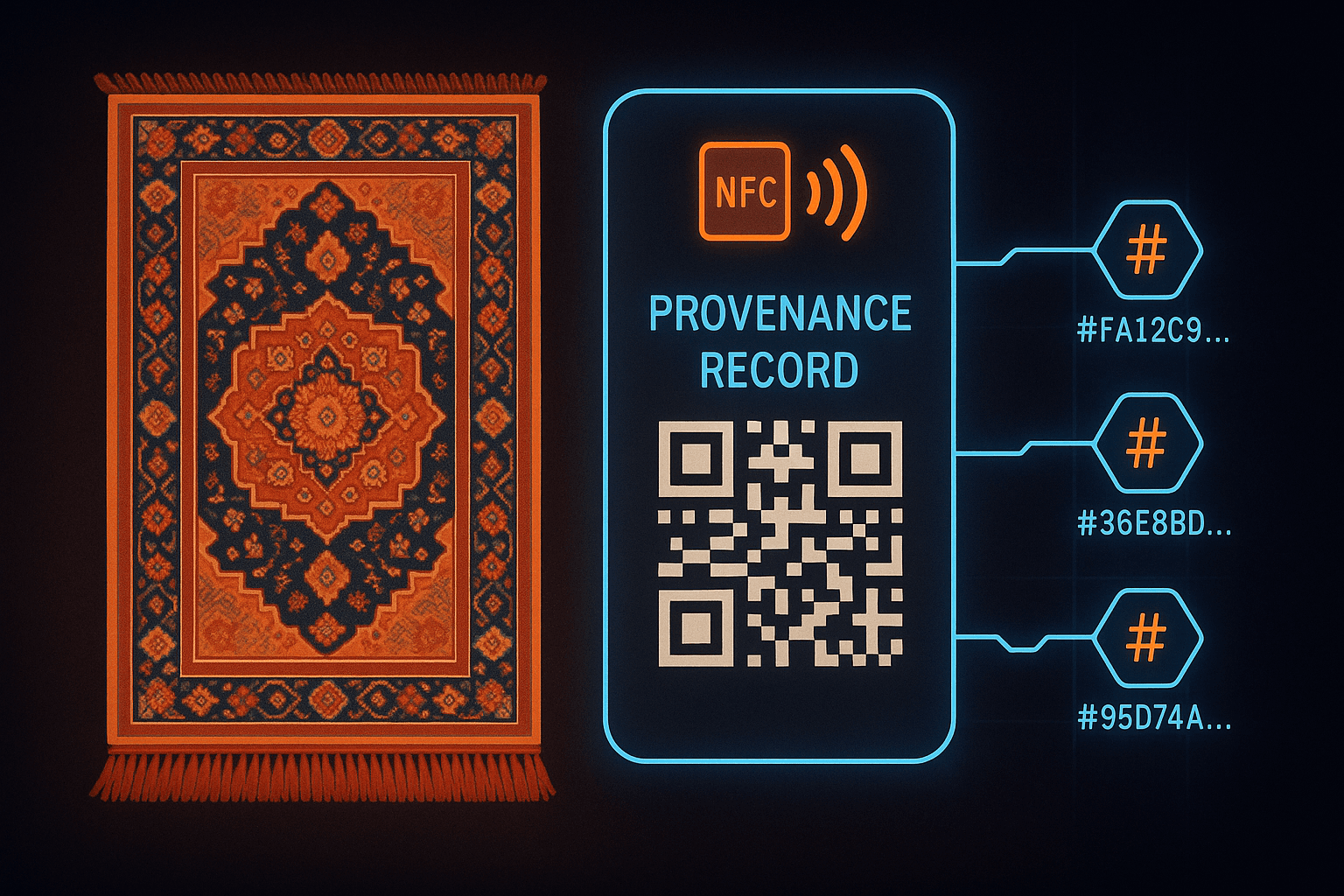
Verifiable provenance protects the story, authorship, and value of cultural artifacts. In practice, you do not need a blockchain for every step. Start with cryptographically signed records that bind a physical item to a digital identity. Add on-chain anchors only where they add clear value, such as public registries for high value works, time stamping key events, or enabling secondary market transfers.
This guide explains the minimal architecture for trustworthy provenance, design choices that matter in the real world, and a staged roadmap to evolve from simple signatures to a fully interoperable registry. The goal is reliability, not hype: collectors and institutions should be able to verify claims anywhere, with or without your app.
Core idea: each artifact gets a durable identifier and a digital twin. Stakeholders issue signed claims about the artifact, such as creation, appraisal, restoration, ownership transfer, or exhibition history. Claims are stored off chain for flexibility and privacy, but each claim can be anchored on chain by hashing its contents and recording the hash with a timestamp and issuer address. Anyone can later verify that the off chain claim existed unchanged at that time and was signed by the stated party.
Physical to digital binding is the hardest part. Options include tamper evident QR or NFC tags, covert markers embedded in labels, or high resolution fingerprinting of the artifact's weave or texture patterns. Whichever method you choose, document the binding method in the claim and make replacement procedures auditable to prevent silent tag swaps.
Use open formats to avoid vendor lock in. Decentralized identifiers (DID) and W3C Verifiable Credentials (VC) give you a vendor neutral way to express claims such as Maker Certificate, Ownership Attestation, Restoration Report, or Exhibition Record. Each VC is signed by the issuer's private key and includes machine readable metadata and human readable evidence.
On chain anchoring is optional but powerful. By writing a small, cheap transaction that records the hash of a claim or batch of claims, you get an immutable timestamp and a public anchor that any verifier can reference. For collections that need tradable proofs, issue a token that references the same content hash. If a token is transferable, encode transfer rules and royalty logic in the contract; if it is non transferable, restrict it to identity or authenticity attestations.
Choose chains for your users, not just your engineers. For public anchors, prefer widely monitored networks with strong liveness guarantees and tooling. Layer 2 networks can reduce fees. If you serve institutions that require permissioned environments, mirror the anchoring on an enterprise chain and publish periodic checkpoints to a public chain for auditability.
Privacy first. Keep sensitive data off chain and store only content hashes or redacted references on chain. Separate public and private claims. For example, make the Maker Certificate public, but keep the exact owner address or home location private. When needed, use selective disclosure VCs or present derived proofs that confirm a fact without revealing raw data.
Design the registry as a set of small, composable records. A practical schema includes: Artifact Profile (static facts like title, materials, dimensions, origin), Maker Certificate (signed by creator or workshop), Provenance Events (transfers, exhibitions, appraisals), Condition and Restoration Reports, and Compliance Attestations. Each record has an ID, a hash, an issuer DID, a signature, and optional on chain anchor references.
Verification should work in two taps. A gallery visitor scans a QR or taps an NFC tag, the verifier fetches the latest artifact profile and claims, checks signatures and anchors, and shows a clear result: valid, partially valid, or invalid. Provide details on which signatures or anchors failed and let the user inspect raw data, hashes, and transaction links.
Think about failure and recovery. Tags get damaged, keys get lost, contracts need upgrading. Define processes for re tagging, claim revocation, key rotation, and contract migration. Use multisig or hardware backed keys for institutions. For artisans, consider custodial key options with secure recovery that do not trap them in a closed platform.
Interoperability beats features. Map your metadata to existing art market vocabularies where possible. Provide an open API for read only access, plus export tools that package claims and media with checksums for archival. Your system should degrade gracefully if your servers are offline: a user with the JSON claim package and blockchain access should still verify core facts.
Costs matter. Most provenance events do not need individual on chain transactions. Use batched anchors (Merkle trees) to represent hundreds of claims with a single hash and provide inclusion proofs to verifiers. Keep large media off chain with content addressing and pinning. Reserve per item tokens for cases where tradability or marketplace integration is essential.
Risk management is part of provenance. Define a lightweight ethics and authenticity review for new makers, include tamper evidence logs for tag replacement, and support dispute workflows where third parties can add counter claims. Transparency about uncertainty builds more trust than pretending every claim is perfect.
KPIs for a healthy provenance program are practical: percentage of artifacts with at least one signed Maker Certificate, percentage with a verified transfer history, mean time to verify for a random visitor, percentage of invalid or disputed claims detected, and successful independent verification rate by external auditors.
Case study example: a hand knotted Persian carpet. The workshop issues a Maker Certificate VC with high resolution loom photos and knot density. A tamper evident NFC tag links the carpet to its digital twin. The certificate hash is anchored on a public chain via a batched transaction, and a non transferable authenticity token is minted to the workshop DID. When the carpet is sold, a dealer issues a Transfer VC referencing the same content hash lineage. A museum later exhibits the piece and adds an Exhibition VC. A visitor scans the tag and sees a valid chain of signatures and anchors, while the owner's identity remains private.
Roadmap for teams getting started: Month 1 ship signed Maker Certificates and a public verifier. Month 2 add batched on chain anchors and revocation lists. Month 3 integrate transfer attestations and a simple registry UI. Month 4 pilot NFC tags with tamper evidence and document re tagging protocol. Keep each step boring, auditable, and reversible.
The end state is simple to describe and hard to fake: artifacts carry portable, cryptographically verifiable stories. Makers get durable credit, collectors get confidence, and culture gets preserved with integrity.
Trustworthy provenance is not about putting everything on chain. It is about making the important claims verifiable, portable, and hard to fake.
From paper certificates to verifiable provenance
- Bind physical items to digital twins using tamper evident tags or fingerprints.
- Use DIDs and Verifiable Credentials to express signed claims.
- Store claims off chain, anchor their hashes on chain when it adds value.
- Batch anchors to control cost and provide inclusion proofs.
- Separate public from private data and support selective disclosure.
- Define revocation, key rotation, and re tagging procedures up front.
- Offer a two tap verifier that works online and offline with claim packages.
- Favor open schemas, exports, and read only APIs for interoperability.
- Measure verification speed, coverage, and dispute resolution outcomes.
- Evolve gradually from signatures to registries to optional tokens.