
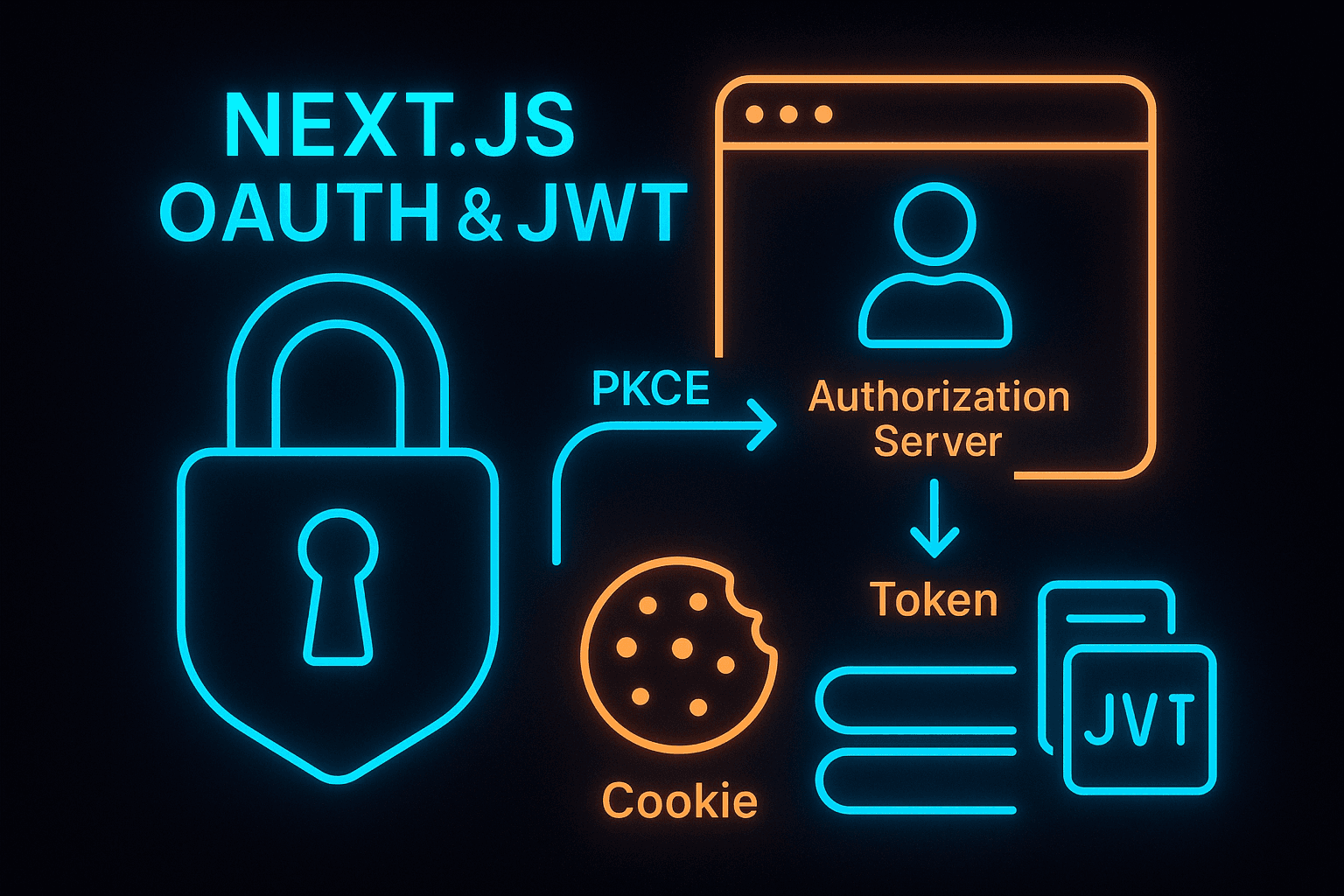
Secure authentication in a modern Next.js app is more than a pretty login button. You need a clear threat model, correct OAuth flows, short-lived session tokens, robust refresh rotation, CSRF and clickjacking protections, and the observability to debug incidents quickly. This guide is a practical blueprint that balances developer ergonomics with strong security defaults.
Architecture at a glance: the browser initiates OAuth with a provider, obtains an authorization code, and exchanges it server-side for provider tokens. Your auth server issues a short-lived access JWT for APIs and a long-lived refresh token stored in a hardened cookie. You rotate refresh tokens on every use, revoke on compromise, and require proof-of-possession where feasible. All stateful decisions happen on the server; the client never persists secrets in localStorage.
Use the Authorization Code with PKCE flow for public clients. PKCE protects against code interception by binding the code to a one-time verifier the client proves during token exchange. Always send state and nonce parameters. State defends against CSRF at the OAuth redirect endpoint, and nonce defends OIDC ID token replay.
Run the OAuth code exchange strictly on the server. In Next.js App Router, implement the callback route as a server action or a route handler under app/api. Never exchange the code on the client. Validate the provider issuer, audience, signature, expiry, nonce, and authorized party before trusting any claims.
Session strategy: issue short-lived access JWTs (for example 5 to 15 minutes) and pair them with httpOnly, secure, sameSite cookies that carry a signed session pointer. Store the refresh token in a httpOnly, secure, sameSite=strict cookie bound to the primary domain. Avoid localStorage for anything sensitive because of XSS exposure and lack of httpOnly semantics.
JWT design: include standard claims (iss, aud, sub, iat, exp) and add a jti for uniqueness, a sid for session, and a scp or roles array for authorization. Keep JWTs small and avoid embedding large user profiles. Use a kid header and publish a JWKS for key rotation. Set exp aggressively; do not rely on revocation to correct overly long access lifetimes.
Signing keys and rotation: use asymmetric signing (RS256 or ES256) for JWTs so that verification can happen across services without sharing private keys. Rotate keys regularly and keep at least one previous key in the JWKS during a grace period. Automate the roll with CI and alarms for stale keys.
Refresh tokens: issue opaque, random 256-bit tokens or signed JWT refresh tokens with minimal claims and a jti. Store refresh tokens server-side as a hashed value (for example using SHA-256 or Argon2id) mapped to a session record with status, device metadata, last used time, and rotation counter. Never log raw tokens. On use, perform rotation: invalidate the old record, create a new one with a new token, and return it. If an old token is presented after rotation, mark the session as compromised and force reauthentication.
Token binding options: for higher assurance, bind refresh tokens to a user agent fingerprint or a TLS client certificate. At minimum record IP and UA to aid anomaly detection. Be careful with strict binding in mobile networks or corporate proxies to avoid false positives.
CSRF protection: for same-site web apps prefer sameSite=strict cookies for refresh tokens and session pointers. For APIs that accept cookie credentials, implement double-submit CSRF tokens or a Synchronizer Token pattern. For OAuth redirect endpoints, validate the state parameter and require POST for sensitive actions. Disable credentialed CORS except for explicit origins.
Defense against XSS: treat XSS as an auth bypass. Enforce a strict Content Security Policy with nonces for inline scripts, disallow eval, and restrict connect-src to known hosts. Escape all untrusted output, sanitize user HTML, and prefer React server components for less client-side surface area. If XSS lands, httpOnly cookies still protect tokens from direct theft.
Same-origin session vs API tokens: for server-rendered pages, rely on a server session derived from your session cookie and do not expose access tokens to the client. For client-side data fetching, call your own Next.js API routes that validate the cookie server-side and then proxy to upstream services with a server-side token. This preserves the httpOnly boundary while enabling rich UX.
Scopes and least privilege: request minimal scopes from providers. Translate provider identities to your internal user model and issue first-party roles and permissions that are decoupled from provider tokens. Never rely on provider scopes to authorize access to your own resources.
Logout and revocation: implement both soft and hard logout. Soft logout clears cookies on the device. Hard logout also revokes the server-side session, deletes active refresh records, and optionally calls the provider revocation endpoint. Protect logout endpoints from CSRF by requiring POST with a CSRF token or sameSite protections.
Account linking: when allowing multiple OAuth providers per account, require a verified email match or a signed challenge with the primary session. Record provenance for each linked identity and show it in the security UI. Do not link accounts purely on email if the provider does not verify that email.
Multi-factor authentication: offer TOTP and WebAuthn. Prefer WebAuthn for phishing resistance. Capture and store MFA enrollment state server-side and prompt for step-up MFA when sensitive actions occur, not only at login. For recovery, issue one-time codes and strongly verify identity before disabling MFA.
Device and session management UI: show active sessions with device name, last active, and location approximations. Allow users to revoke any session instantly. Provide a security events log for sign-ins, password changes, MFA changes, and account links. This interface is a powerful fraud early-warning channel.
API gateway and rate limits: throttle login, callback, and token endpoints per IP and per user with leaky bucket or token bucket algorithms. Add incremental backoff on failures and generic error messages for username or email enumeration resistance. Monitor unusual spikes and block abusive ASNs as needed.
Instrumentation and audit: assign correlation IDs to every auth request and propagate them through redirects and callbacks. Log structured events at INFO for normal flows and WARN for anomalies. Never log tokens or PII. Emit metrics for login success rate, callback error rate, refresh rotation failures, CSRF violations, and key age. Build runbooks with exact queries and dashboards.
Testing strategy: write unit tests for JWT verification, clock skew handling, and CSRF utilities. Add integration tests that simulate the full OAuth dance with a mock provider. Use Playwright to validate cookie flags, sameSite behavior, and CSP headers in a real browser context. Test refresh rotation race conditions by firing concurrent refresh requests and verifying that only one succeeds.
Next.js specifics: in the App Router, place auth routes under app/api/auth and mark handlers as dynamic or use Route Handlers to avoid caching. Use cookies from next/headers only on the server. Ensure that fetch requests to your API do not set cache headers for personalized responses. For edge runtime, avoid crypto that is not WebCrypto compatible or move token work to node runtime functions.
Libraries vs custom: libraries like NextAuth can accelerate OAuth integrations and session handling. If you roll your own, keep the interfaces small: a ProviderClient for each OAuth provider, a TokenService for JWTs, a SessionStore for refresh records, and a CsrfService. Whether library or custom, do not compromise on rotation, revocation, and cookie hygiene.
Authorization is not authentication: centralize authorization checks in middleware or use-case layer. Express rules as code and data, not scattered if statements. For example, define canEditPost(user, post) policies and write tests. Consider attribute-based access control for multi-tenant and row-level constraints.
Prod checklists worth adopting: CSP enabled with nonces, HSTS with preload, secure and httpOnly cookies, sameSite=strict where possible, referrer policy strict-origin-when-cross-origin, frame-ancestors none or a tight allowlist, X-Content-Type-Options nosniff, and a well-scoped CORS policy. Verify all of these in CI with an automated security headers test.
Threat scenarios to model: stolen laptop with an open browser session, malicious extension attempting XHR to your APIs, OAuth code interception by a proxy, third-party script compromise, CSRF to the logout endpoint, refresh token replay after rotation, and key compromise. For each, document the expected blast radius and the controls that contain it.
Case study: a Next.js admin app with Google OAuth, RS256 access JWTs (10 minutes), and opaque refresh tokens (30 days). Refresh tokens are hashed in a sessions table with rotation counter. Cookies are secure, httpOnly, sameSite=strict for refresh and lax for session pointer. CSRF uses double-submit tokens on POST. After an incident with concurrent refresh replay, the team implemented strict rotation with token family invalidation and added UA binding. Replay attempts now invalidate the family and force a fresh login. Median login time stayed under 400 ms, and CSRF errors dropped by 94 percent after enforcing state validation on callbacks.
Bottom line: secure auth is a product feature. Keep tokens short-lived, rotate refresh aggressively, protect boundaries with cookies and CSRF tokens, and observe everything. When you can explain what happens at each step and prove it with logs and metrics, you have an authentication system users and auditors can trust.
Short-lived tokens, strict cookies, and refresh rotation turn a login screen into a defensible security boundary.
From login buttons to production-grade auth
- Use OAuth Authorization Code with PKCE, state, and nonce.
- Exchange codes only on the server and validate provider claims.
- Issue short-lived access JWTs and rotate refresh tokens on every use.
- Store tokens in secure, httpOnly, sameSite cookies instead of localStorage.
- Adopt strict CSP, HSTS, and a tight CORS policy.
- Protect cookie-backed endpoints with CSRF tokens or sameSite=strict.
- Sign JWTs with asymmetric keys, publish JWKS, and rotate keys routinely.
- Provide device and session management with instant revocation.
- Instrument auth flows with structured logs, metrics, and runbooks.
- Test rotation races, CSRF, and browser cookie behavior end to end.